
Home / Insights / MarTech updates
WhatsApp Marketing Costs Went Up. Here's How to Send Fewer, Better Messages.
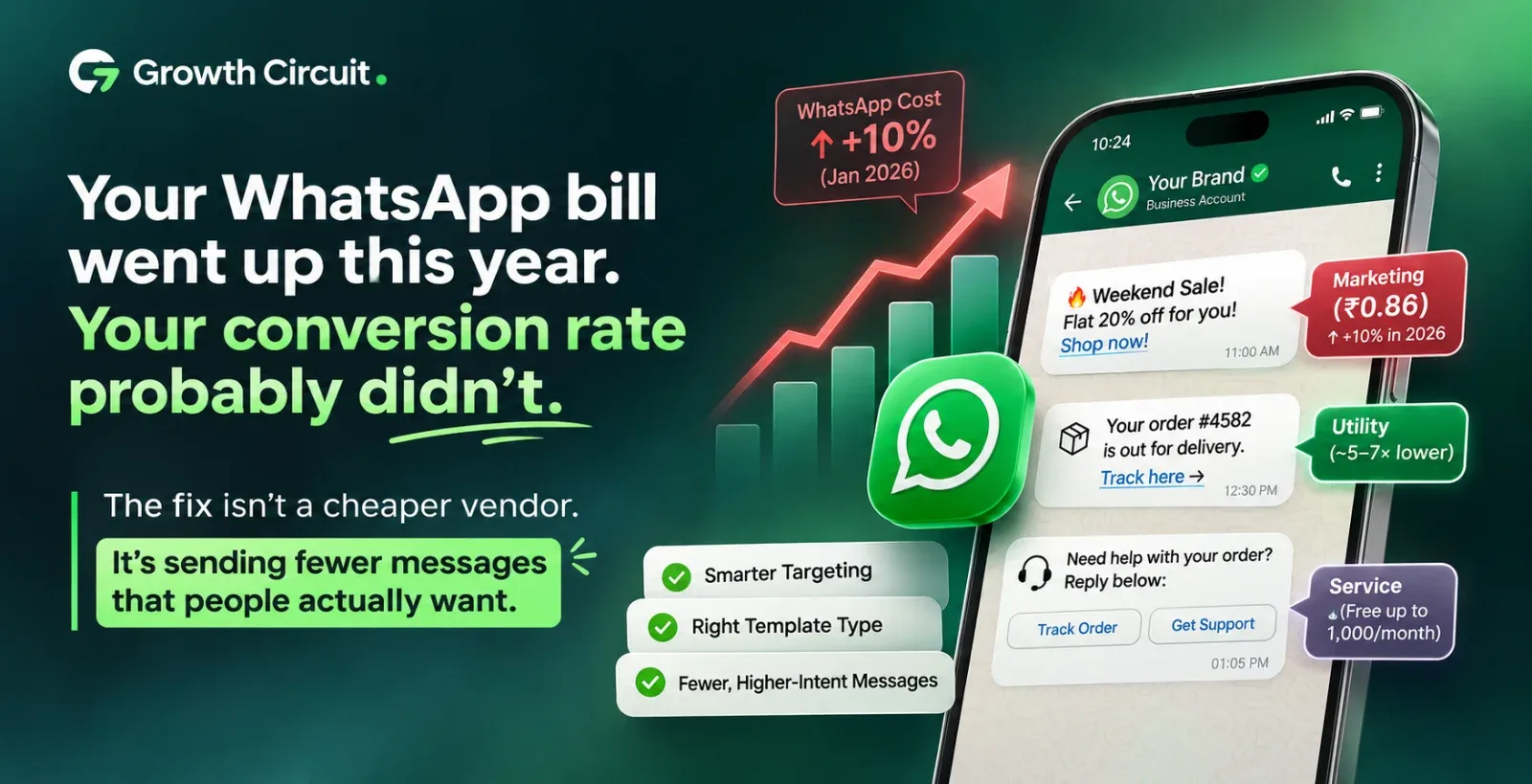
Your WhatsApp bill went up this year. Your conversion rate probably didn't. The fix isn't a cheaper vendor. It's sending fewer messages that people actually want.
Updated November 2026
What changed in 2026
- Per-message billing. Since July 2025, Meta charges for every delivered template message, based on its category and the customer's country. Every send is now a line item.
- Marketing messages cost more. On 1 January 2026, India's marketing rate went up about 10%, from roughly ₹0.78 to ₹0.86 per message. Your provider's markup and 18% GST sit on top.
- Support isn't free anymore. From 1 October 2026, replies inside the 24-hour customer service window are charged once a number crosses 1,000 service messages in a month. Utility templates sent inside that window are charged too.
Here's how that adds up. A brand sending a weekly offer to 5 lakh contacts spends about ₹4.3 lakh per blast at Meta's rate, before markup and GST. That's roughly ₹17 lakh a month. If half that list hasn't opened a WhatsApp message in 90 days, around ₹8.5 lakh a month is paying to be ignored. (Illustrative numbers. Plug in your own.)
8 ways to send fewer, better WhatsApp messages
1. Stop blasting. Segment by engagement.
Split your list by recent behaviour: read a message in the last 30, 60 and 90 days, clicked, purchased. Send full campaigns only to the warm groups. Move cold users to cheaper channels, or to a short win-back sequence with a clear end date. RFM (recency, frequency, monetary value) is a simple place to start.
2. Classify templates correctly
This is the quietest money leak in WhatsApp marketing. Order updates, payment receipts, appointment reminders and delivery alerts belong in the utility category, which costs a fraction of marketing. Getting this right can cut the per-message cost five to seven times.
Be careful, though. Slip a discount code into a utility template and it gets reclassified as marketing. Keep transactional messages clean, and put the offer in a separate, well-timed message.
3. Cap frequency across every channel
A customer who got a push in the morning, an email at lunch and a WhatsApp in the evening doesn't feel valued. They feel hunted. Set one global frequency cap across all channels, not one per channel. A good starting rule is one promotional WhatsApp message per user every 48 to 72 hours, adjusted by segment.
4. Give each channel the job it does best
WhatsApp is your premium channel, so save it for high-intent moments: a high-value cart abandoned, a renewal due tomorrow, an appointment slot about to expire. Use push, email, in-app and RCS for awareness, content and low-stakes nudges. The right channel mix often lowers cost and lifts response at the same time.
5. Trigger on behaviour, not the calendar
"Tuesday sale blast" is a calendar message. "You viewed this twice and it's back in stock" is a behaviour message. Behaviour-triggered journeys go to fewer people and convert far better, because the timing comes from the customer rather than your content calendar.
6. Resolve support in fewer replies
Now that service messages carry a price, a flow that sends "Hi!", then a menu, then "Got it", then the answer costs four charges. Merge them into one useful reply. Use buttons and lists so customers can choose in a single tap, and check which bot flows add steps without adding information.
7. Use Click-to-WhatsApp ads as an entry point
When a customer reaches you through a Click-to-WhatsApp ad or a Facebook page button, a 72-hour free messaging window still applies. If you already spend on Meta ads, routing high-intent traffic this way can bring your messaging cost per lead down.
8. Measure lift, not reach
Delivered and read rates tell you WhatsApp worked. They don't tell you the campaign worked. Hold back 5 to 10% of every audience as a control group, then compare conversions. The number that matters is incremental revenue per rupee spent. If a campaign doesn't beat its control group, stop sending it, however good the read rate looks.
Metrics to track instead of "messages sent"
- Cost per conversion: total WhatsApp spend divided by conversions.
- Revenue per message delivered: shows which campaigns earn their cost.
- Incremental lift vs control: the real impact of each campaign.
- Opt-out and block rate: a high block rate hurts your quality rating and, over time, your sending limits.
- Share of sends to engaged users: you want this number going up.
Quick checklist before your next campaign
- Is this audience engaged in the last 60 to 90 days?
- Is the template in the right category?
- Has this user already heard from you on another channel today?
- Is WhatsApp the best channel for this message?
- Is there a control group?
Five yes answers, and you're sending fewer, better messages.
FAQs
How much does a WhatsApp marketing message cost in India in 2026?
Meta's India rate is about ₹0.86 per delivered marketing message since January 2026, plus your provider's markup and 18% GST. Rates can change each quarter, so check Meta's official pricing page before you set a budget.
What is the difference between a utility and a marketing template?
Utility templates confirm or update something the customer already started, such as an order, payment or booking. Marketing templates promote, upsell or re-engage. Utility messages cost much less, but any promotional content in one gets it reclassified as marketing.
Are WhatsApp service messages still free?
Not entirely. Since October 2026, each business phone number gets 1,000 free service messages a month. Every delivered message after that is charged.
How can I reduce WhatsApp marketing costs without losing sales?
Send to engaged segments only, classify templates correctly, cap frequency across channels, trigger on behaviour and measure every campaign against a control group.
Is WhatsApp still worth it for marketing in India?
Yes, for high-intent moments. India is still one of the cheapest markets in the world for WhatsApp messaging. The waste comes from blasting everyone, not from the channel itself.
Find out how much of your WhatsApp spend is wasted
Start with our CRM audit checklist, or book an intro call and we'll map where your messages leak money.